A dental health plan is a structured programme that provides financial coverage for essential dental services, helping individuals and families access preventive and restorative care at a lower cost. In Canada, these plans fall into two main categories: government-funded programmes like the Canadian Dental Care Plan (CDCP), and private dental insurance plans purchased individually or through an employer. Understanding what a dental health plan includes, and which type suits your situation, is one of the most practical steps you can take for your family’s oral health. The CDCP now covers approximately 6 million Canadians, saving eligible members roughly $800 annually on dental care.
What is a dental health plan and what does it cover?
A dental health plan is a formal agreement that pays for a defined set of oral health services, either in full or in part. The specific services covered depend on the type of plan you hold, but most plans organise coverage into three tiers: preventive care, basic restorative care, and major restorative care.

Preventive care
Preventive services form the foundation of nearly every plan. These include:
- Routine dental cleanings and scaling
- Comprehensive oral exams
- Dental X-rays
- Fluoride treatments
- Polishing
Preventive care is the most consistently covered category. Most plans cover two cleanings per year, and some extend to three for patients with gum disease. Staying on top of regular dental visits is the single most effective way to keep your out-of-pocket costs low.
Basic restorative services
Basic restorative care covers treatment for problems that have already developed. Common inclusions are:
- Tooth-coloured and amalgam fillings
- Simple tooth extractions
- Root canals on certain teeth
- Periodontal treatment for gum disease
Plans often apply frequency limits here. For example, a filling on the same tooth may only be covered once every two years.
Major restorative and other services
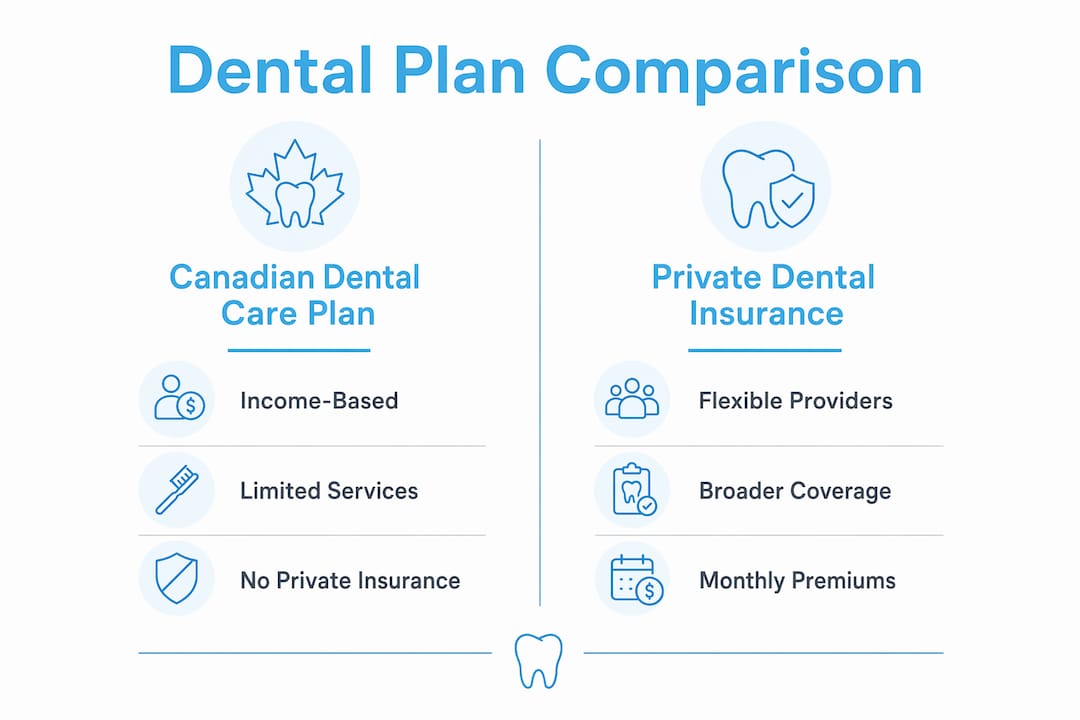
Major services typically include crowns, bridges, dentures, and oral surgery. These carry higher costs and are often covered at a lower percentage, such as 50%, with the patient paying the remainder. The CDCP covers cleanings, fillings, extractions, root canals, dentures, and periodontal care, but excludes implants, cosmetic procedures, and most orthodontic treatment. That exclusion matters for families with teenagers who may need braces.
How does the Canadian Dental Care Plan work, and who qualifies?
The Canadian Dental Care Plan is a federal government programme designed to help Canadians who have no access to private dental insurance. It launched in late 2023 and expanded through 2025, making it one of the most significant changes to dental coverage in Canadian history.
Eligibility requirements
To qualify for the CDCP, you must meet all three of the following conditions:
- Be a Canadian resident with a valid Social Insurance Number
- Have filed your taxes in the prior year
- Have no access to private dental insurance, either through an employer or a personal plan
The CDCP excludes anyone with existing group or personal dental coverage. If your employer offers dental benefits and you decline them, you are still considered to have access to private coverage and will not qualify.
Co-payment structure
The CDCP uses an income-based co-payment model. Co-payments range from 0% to 60% depending on your household income:
- Households earning under $70,000: no co-payment
- Households earning $70,000 to $79,999: 40% co-payment
- Households earning $80,000 to $89,999: 60% co-payment
- Households earning $90,000 or more: not eligible
That sliding scale means a family earning $68,000 pays nothing at the dental chair for covered services, while a family earning $85,000 pays 60 cents of every dollar.
How billing works
CDCP-registered dentists bill the plan directly, so eligible patients do not pay upfront for covered services. If your dentist does not participate in the CDCP, you pay the full cost and submit a claim yourself. Always confirm your dentist’s participation status before booking an appointment.
Pro Tip: Search the federal government’s CDCP provider directory online before your next appointment. Calling ahead to confirm participation takes two minutes and can save you hundreds of dollars.
The CDCP also requires annual requalification. Your income and insurance status are reviewed each year, so a change in employment or income could affect your eligibility.
What are the differences between private dental insurance and the CDCP?
Private dental insurance and the CDCP both reduce the cost of dental care, but they work very differently. Knowing those differences helps you choose the right coverage for your family.
| Feature | CDCP | Private dental insurance |
|---|---|---|
| Eligibility | Income-based, no private coverage | Open to most Canadians |
| Services covered | Basic and major dental care | Basic, major, and often cosmetic or orthodontic |
| Implants and cosmetic work | Not covered | Often covered depending on plan |
| Cost structure | Co-payments based on income | Monthly premiums plus co-payments |
| Provider flexibility | Must use registered dentists | Most licensed dentists accepted |
| Duration | Annual requalification required | Lifetime coverage while premiums are paid |
| Orthodontics | Excluded unless medically necessary | Included in many plans |
Private plans cover a broader range of services, including implants and some cosmetic work, which the CDCP does not touch. That broader scope comes at a cost: monthly premiums, annual maximums, and sometimes waiting periods before major services are covered.
Private insurance also gives you more flexibility in choosing a provider. You are not restricted to a registered network, which matters in smaller communities like Orangeville where provider choice can be limited.
Pro Tip: Do not cancel your private dental insurance simply because the CDCP exists. The CDCP is a subsidy for basic care, not a full replacement. Private plans offer broader protection, and losing that coverage is difficult to reverse if your income later rises above the CDCP threshold.
Private dental insurance plans often include annual maximums, waiting periods, and monthly premiums, which differ significantly from the CDCP’s co-payment framework. These differences affect how predictable your dental costs are from year to year.
How can families choose the best dental health plan for their needs?
Choosing the right dental coverage starts with an honest look at your family’s dental health needs and your household budget. There is no single plan that works for everyone, but a clear process makes the decision much easier.
- Assess your dental care frequency. Families with young children, seniors, or anyone with a history of gum disease typically need more frequent visits. A plan with strong preventive coverage pays off quickly for high-frequency users.
- Calculate your real out-of-pocket costs. Compare the annual premium of a private plan against your expected dental bills. If your family spends less than the premium on dental care in a typical year, a lower-tier plan may be sufficient.
- Check CDCP eligibility first. If your household income falls below $90,000 and you have no private coverage, the CDCP is worth applying for. Even a 40% or 60% co-payment reduces your costs meaningfully on larger procedures.
- Confirm provider participation. Whether you use the CDCP or a private plan, verify your dentist participates before assuming your costs are covered. Non-participating providers can result in unexpected bills.
- Layer your coverage where possible. If you have employer benefits, check whether they can be coordinated with a provincial programme. Some Ontario residents qualify for both employer coverage and provincial assistance for specific services.
- Consider your family’s specific needs. A family with a teenager who may need orthodontic work should look closely at private plans that include orthodontic coverage, since the CDCP excludes orthodontics unless medically necessary.
For families in Orangeville and Dufferin County, understanding family dental services available locally helps you match your plan to the care you can actually access nearby. If you currently have no coverage at all, there are still affordable dental care options worth exploring before skipping care altogether.
How Healthysmiledentalhygiene can help you get the most from your plan
Choosing a dental health plan is only half the equation. Getting the most from your coverage requires a dental team that understands how plans work and helps you use your benefits wisely.
Healthysmiledentalhygiene in Orangeville offers preventive, restorative, and cosmetic dental care for patients of all ages. The team helps families understand their coverage, navigate the CDCP, and plan their care around their annual benefits. Whether you are using private dental insurance or the federal programme, knowing how to maximise your dental benefits can save your family hundreds of dollars each year. Book a visit with the Orangeville team and get clear, friendly guidance on your options.
Key takeaways
A dental health plan is the most reliable tool for reducing the cost of dental care, and choosing between the CDCP and private insurance depends on your income, family needs, and provider access.
| Point | Details |
|---|---|
| Two main plan types | Canadians can access the federal CDCP or private dental insurance, each with distinct eligibility rules. |
| CDCP income threshold | Households earning under $90,000 with no private coverage may qualify for the CDCP. |
| Co-payment structure | CDCP co-payments range from 0% to 60% based on household income, with lower earners paying nothing. |
| Private plans offer more scope | Private insurance covers implants, cosmetic work, and orthodontics that the CDCP excludes. |
| Confirm provider participation | Always verify your dentist is registered with the CDCP or accepts your private plan before booking. |
FAQ
What is a dental health plan in Canada?
A dental health plan is a programme that covers part or all of the cost of dental services, including cleanings, fillings, and major restorative work. In Canada, coverage comes through either the federal Canadian Dental Care Plan or private dental insurance.
Who qualifies for the Canadian Dental Care Plan?
The CDCP is open to Canadian residents who have filed taxes in the prior year, have no access to private dental insurance, and have a household income below $90,000 annually.
Does the CDCP cover the same services as private dental insurance?
The CDCP covers basic and major dental care but excludes implants, cosmetic procedures, and most orthodontics. Private dental insurance plans often include these services depending on the plan selected.
Can I have both the CDCP and private dental insurance?
No. The CDCP requires that you have no access to private dental insurance. If you hold a private plan, you are not eligible for the CDCP, regardless of your income.
What happens if my dentist does not participate in the CDCP?
If your dentist is not registered with the CDCP, you pay the full cost upfront and submit a claim for reimbursement yourself. Choosing a participating dentist avoids this and allows for direct billing.